Garmin Smart Scale Lawsuit: Are Body Composition Claims Accurate?
James Moore ·
Listen to this article~4 min
A class-action lawsuit filed against Garmin alleges its $199 Index S2 Smart Scale misleads consumers about body composition accuracy, citing study data showing errors up to 17.6 pounds.
A class-action lawsuit is shaking up the smart scale market. Filed in the US District Court of Northern Illinois, it targets Garmin International over its $199 Index S2 Smart Scale. The suit alleges that Garmin misled consumers by claiming the scale accurately measures body composition. While the exact damages aren't specified, standard legal language suggests the amount exceeds $5 million, not including interest and costs.
### How BIA Technology Works
Smart scales like the Garmin Index S2 use a method called bioelectrical impedance analysis (BIA) to estimate body composition. Here's the gist: the scale sends a tiny electrical current through your body and measures how much resistance it encounters. Based on that resistance, it calculates total body water. From there, it estimates muscle mass and body fat percentage.
But here's the thing—BIA isn't perfect. A Wikipedia entry on the topic notes that "many of the early research studies showed that BIA was quite variable, and it was not regarded by many as providing an accurate measure of body composition." Factors like hydration can throw off the results. As the article points out, "Although the instruments are straightforward to use, careful attention to the method of use (as described by the manufacturer) should be given." So even the experts say you need to follow instructions closely.
### Why Foot Sensors Fall Short
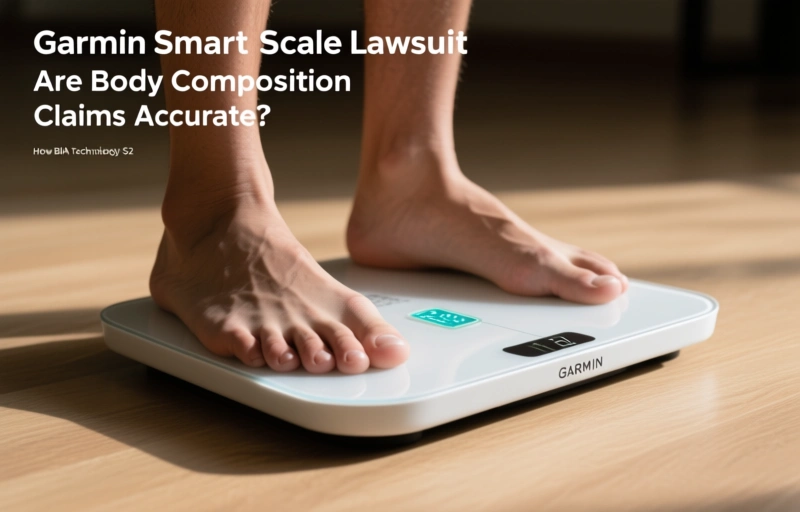
Most smart scales, including Garmin's, use foot sensors for BIA. You step on the scale barefoot, and a current goes through one foot while resistance is measured at the other. This is called two-point BIA. The lawsuit claims that "the foot-to-foot BIA technology in the Smart Scale is incapable of accurate body composition measurements, rendering Garmin's representations regarding the Smart Scale's capabilities false, misleading, and deceptive to consumers."
The problem? Measuring BIA through the feet only captures resistance from the waist down. Depending on your body shape, this can under- or over-estimate body fat. A 2021 study in JMIR mHealth uHealth compared foot-to-foot smart scales with DEXA scans (the gold standard) and found that the devices underestimated both fat and muscle mass by as much as 17.6 pounds, or up to 8 percentage points. That's a big deal if you're tracking progress.
### What About Four-Point BIA?
For better accuracy, some scales use four-point BIA. They measure resistance at four points—typically both feet and both hands. This gives a more complete picture because it captures the whole body, not just the lower half. But most budget-friendly smart scales, like Garmin's, stick with two-point BIA.
### Garmin's Claims Under Fire
The suit focuses on Garmin's marketing. On its website, the Index S2 product page has a banner that says, "Accuracy matters when it comes to your goals." But it doesn't explicitly say the scale is accurate. However, an Amazon listing is more direct: buyers "get accurate measurements for weight, weight trend, body fat percentage, BMI, skeletal muscle mass, and more." The plaintiff argues these claims are misleading.
Garmin isn't alone here. A quick search on Amazon shows dozens of two-point BIA smart scales making similar promises. The lawsuit, filed on May 29, 2026, by Victor Maurer, claims Garmin "failed to disclose to Plaintiff and other Class Members vital information regarding the Smart Scale's inability to accurately measure body composition." The plaintiff is seeking monetary damages and a declaration that the scale "cannot accurately measure" body composition.
### What This Means for You
If you own a Garmin Index S2 or are thinking about buying one, this lawsuit raises important questions. Are you getting accurate data? Or are you just paying for a fancy scale that gives you rough estimates? The truth is, any BIA scale has limitations. Hydration, food intake, and even your foot placement can affect readings. For serious athletes or anyone tracking body fat changes, a DEXA scan or professional assessment might be more reliable.
For now, the case is ongoing. We'll keep an eye on it and update you as new details emerge.